
What programmatic SEO is
Programmatic SEO is the creation of many landing pages from one template and a dataset, each targeting a specific search such as "service in city" or "product for use case". Done well, every page gives the visitor unique, useful information. Done badly, it produces thousands of near-duplicate pages that Google treats as scaled content abuse.
The difference is in the data and the controls: what makes each page unique, which pages deserve to exist, how they link to each other and how indexation is monitored. That is where I spend most of the effort.
New to this? Start with the plain-language guide: What is programmatic SEO, and when does it make sense?
What's included
Data and demand research
Keyword patterns, search volume by location or category and the data that makes each page useful.
Template design
Page templates with unique blocks per page, not just a swapped city name.
Architecture and linking
State, city and category hubs with internal links that spread authority.
Indexation control
Rules for which pages are published, indexed or held back until they have enough data.
Schema at scale
Structured data generated per page and validated in batches.
Performance tracking
Search Console monitoring by page group to prune, merge or expand.
Who it is for
- Directories and marketplaces with listings across many locations.
- National service brands that need a page per city or state.
- SaaS and B2B companies with many integrations, use cases or comparisons.
- Businesses with a proprietary dataset that people search for.
How it works
- 01
Free diagnosis
We check whether your market has a repeatable search pattern worth building for.
- 02
Research and data
Keyword patterns, demand by page type and the data sources for each block.
- 03
Template and pilot
A template and a pilot batch of pages, measured before scaling.
- 04
Scale
Publishing in batches with hubs, internal links, sitemaps and schema.
- 05
Pruning and growth
Monthly review by page group: improve, merge or remove what does not perform.
A pilot batch is usually ready in 3 to 4 weeks. Scaling depends on data and platform.
Pricing
Built as a project, then maintained monthly.
Programmatic SEO strategy
from $600Demand research, data plan, template spec and pilot scope.
Template and pilot build
from $1,500Template, data integration and first batch of pages on your CMS.
Service or location page
$90For hand-written pages that complement the template.
Monthly programmatic SEO
$2,500 / monthPart of the Scale plan.
Programmatic and catalog SEO are part of the Scale plan. See all plans and prices.
Not sure where to start?
Get a free SEO audit. In 30 minutes I show you what is holding your site back and the three changes I would make first.
Real experience behind this service
As SEO manager for a US business group I built and monitored programmatic systems across five websites and tens of thousands of landing pages. For a national recovery-meetings directory, organic performance grew to 1.13M clicks and 19.5M impressions in 16 months (Google Search Console), with daily clicks up from about 700 to 2,300+ and visibility that overtook its main competitor in Semrush (full case study). For fintech brands I built 50+ state pages and 230+ metro pages; for a therapist directory, coverage of all 50 states and thousands of localities.
Proof from real client work
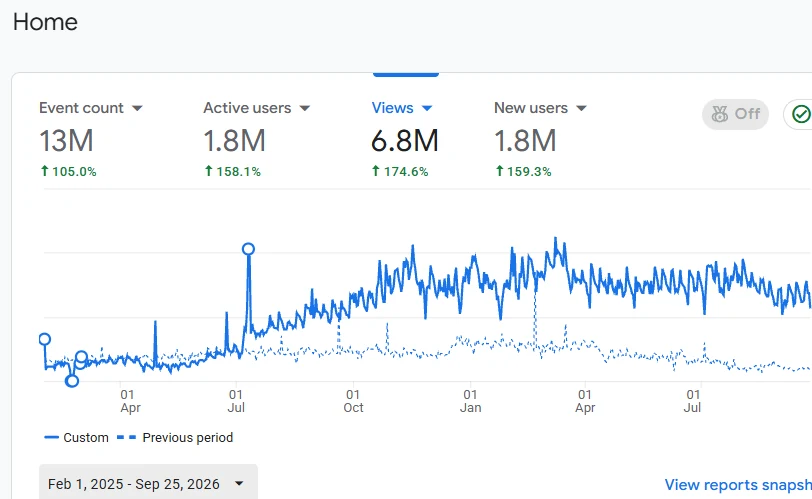
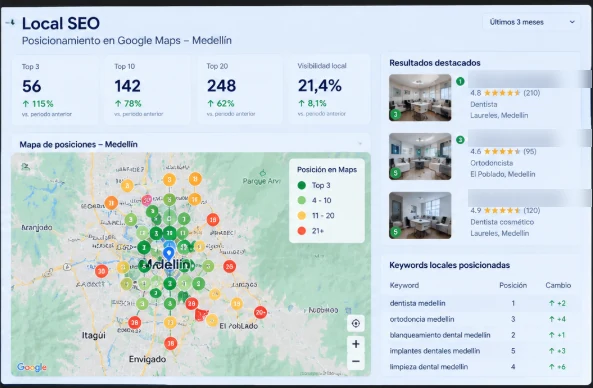
Screenshots from real client work, shared with permission. Names and domains are hidden.
Tools I use
Frequently asked questions
What is the difference between programmatic SEO and traditional SEO?
Programmatic SEO builds many pages from a template and a dataset, while traditional SEO creates and optimizes pages one by one. Both follow the same ranking rules. Programmatic SEO suits large catalogs, directories or service-and-city combinations, but only works when each page has unique, useful data instead of swapped names.
What is programmatic SEO?
Programmatic SEO is the creation of many useful landing pages from a template and a structured dataset, such as one page per service and city or per product type. It works only when every page answers a real search with unique data; pages that just swap a city name are treated as doorway or scaled content spam.
How much does programmatic SEO cost?
A programmatic SEO strategy with me starts at $600, and a template plus pilot batch starts at $1,500 and is usually ready in three to four weeks. Additional service or location pages cost $90 each, and ongoing monthly programmatic SEO costs $2,500, depending on data and platform.
Is programmatic SEO still safe after Google's spam updates?
Yes, if each page has unique, useful data and a real search behind it. Google's spam policies target scaled content created mainly to manipulate rankings. That is why I start with a small pilot, measure indexing and traffic, and only scale the templates that prove useful.
Is programmatic SEO against Google's guidelines?
Not by itself. Google's spam policies target pages made at scale mainly to manipulate rankings with little value. Programmatic pages that give each visitor unique, useful information are fine.
How many pages should I launch?
Start with a pilot of the pages with the most demand and the best data, measure indexation and traffic, then scale. Launching everything at once is the most common mistake.
Which platforms work for programmatic SEO?
WordPress, headless CMSs, Webflow and custom stacks. The best choice depends on your data source and who will maintain it.
Can AI write the pages?
AI can help assemble and vary content, but the value has to come from real data and human review. I use AI in the workflow, not as a replacement for useful information.
Related services
Sources and further reading: Google spam policies: scaled content abuse; Google Search Essentials.